For years, Data Vault 2.0 has been viewed primarily as a data warehousing methodology and modeling technique. In truth, it is a highly scalable approach for integrating enterprise data while preserving history, lineage, and adaptability. But Generative AI is changing the role of Data Vault entirely. And what was once considered a back-end integration architecture is increasingly becoming the foundation upon which intelligent systems reason, learn, and act.
What is fascinating is that Data Vault was never designed for AI. In fact, it was designed to solve a very different problem. Yet the principles that Dan Linstedt introduced decades ago are more relevant today than ever before. As organizations race toward AI-powered copilots, enterprise agents, and autonomous workflows, they are discovering something unexpected. And that is, the hardest problems in AI are often the same problems Data Vault was originally created to solve.
The Original Problem: Enterprise Change
When Dan Linstedt developed Data Vault, organizations were struggling to build data warehouses that could survive the realities of enterprise environments.
- New source systems were constantly being introduced
- Business definitions changed
- Applications were upgraded
- Companies merged
- Processes evolved
Data models that seemed elegant on paper often became unwieldy in production. A relatively small change in an upstream system could trigger cascading redesigns throughout the warehouse. The fundamental challenge was simple:
How do you build a data warehouse that can continuously absorb change without constantly breaking?
Data Vault emerged as an answer to that question. Its core principles were designed to create architectures that were resilient, auditable, and adaptable in the face of continuous change.
Today, Generative AI is exposing those same challenges on an even larger scale. The difference is that AI systems don’t merely consume data. They reason with it. And that changes everything.
Insert-Only Architecture: AI Cannot Reason About What It Cannot Remember
One of the defining characteristics of Data Vault is its insert-only architecture. Data is never updated or deleted in the raw vault. It is only appended.
Historically, this solved problems around auditability, reconciliation, and historical traceability. Organizations could always reconstruct what happened, when it happened, and how the data evolved over time. But Generative AI raises the stakes considerably.
In many ways, deleting historical data is like giving your AI a lobotomy. An intelligent system can only reason about the information it retains. If data is overwritten or discarded, the system loses its ability to understand how entities evolved, how decisions were made, and what changed over time.
The goal is not simply to preserve the current state of the business. The goal is to preserve the story of the business, and AI systems need to understand that story so they can tell it accurately. This means the AI systems need to know:
- What changed
- When it changed
- Why it changed
- What existed before the change occurred
Humans naturally understand that context matters. AI systems require that context to be explicitly preserved. This is where Data Vault’s insert-only architecture ensures that nothing is forgotten. Every state, every version, and every change remains available for future analysis and reasoning. In the AI era, immutable history becomes more than a governance requirement; it becomes organizational memory.
Separation of Business Rules: The Evolution of Separation of Concerns
Another foundational principle of Data Vault is the separation of raw data from business logic. Raw source data is preserved exactly as received, while business rules and transformations are applied separately downstream.
When Data Vault introduced this concept, it was relatively novel within the data warehousing community. But the underlying principle is much larger than Data Vault. Separation of concerns has been one of the defining themes of computer science for decades.
The industry evolved from monolithic applications toward increasingly modular architectures.
We moved from:
- Large procedural programs
- Tightly coupled systems
- Monolithic applications
Toward:
- Object-oriented programming
- Service-oriented architectures
- Microservices
- Event-driven systems
Data Vault’s separation of hubs, links, satellites, and business rules reflects the same architectural trend seen throughout software engineering: isolating concerns so that systems can evolve independently, adapt to change, and remain resilient over time.
Data Vault embraced this philosophy long before it became mainstream. For Generative AI, this separation becomes even more important.
- AI systems continuously evolve.
- Prompts change.
- Embeddings change.
- Semantic models change.
- Business definitions change.
The facts should remain stable even as our interpretation of those facts changes.
Data Vault provides exactly that foundation. It preserves reality first and then interprets it later.
Agility and Resiliency: Designing for Entropy
Perhaps the most important philosophical contribution of Data Vault is that it accepts change as inevitable. Most architectures are designed around stability. Data Vault is designed around change.
The chemistry and physics communities figured this out long ago through the Second Law of Thermodynamics: Entropy increases over time. So too in business systems:
- Systems naturally become more complex.
- Organizations acquire new applications.
- Business processes evolve.
- Definitions change.
- Relationships become more complicated.
In other words, disorder is not an exception. It is the natural state of complex systems. Many enterprise architectures spend enormous effort fighting this reality. Data Vault takes a different approach. It assumes entropy will happen and designs accordingly.
Its Hub, Link, and Satellite architecture allows organizations to continuously absorb new information without constantly rebuilding what already exists. The goal is not to stop change, but rather the goal is to remember enough history that change becomes manageable.
If we know what the business looked like yesterday and we know what it looks like today, then we can understand how it evolved. That ability to maintain continuity across change has become increasingly important for AI systems.
Enterprise AI lives in an environment of constant evolution:
- New data sources
- New agents
- New models
- New workflows
- New business processes
Organizations that design for change will outperform organizations that attempt to resist it. And Data Vault was designed for change from the beginning.
Auditability: Understanding the Business Behind the Data
Traditionally, auditability has been viewed primarily as a governance capability.
- Can we trace where the data came from?
- Can we explain how it moved through the system?
- Can we reconstruct historical states?
Those remain important questions. But Generative AI introduces another dimension. Enterprise agents do not simply need access to data. They need to understand the business processes that produced that data, and every source system represents a set of business activities:
- Customer onboarding
- Loan origination
- Claims processing
- Order fulfillment
- Inventory management
- Account servicing
The data itself is often only a byproduct of those processes. So when lineage is preserved, agents gain visibility into more than just records and fields; they gain insight into how the business actually operates. This is where auditability becomes strategically important.
Strong lineage allows agents to understand:
- Where information originated
- Which systems produced it
- How it moved through the enterprise
- What business process created it
And ultimately, businesses are not driven by data; businesses are driven by processes that produce data.
The more clearly an AI system can understand those underlying processes, the more effectively it can reason, automate, and assist. This transforms auditability from a compliance feature into a foundational capability for enterprise intelligence.
Data Vault’s New Role in the AI Era
Historically, Data Vault sat behind dashboards and reporting systems. The architecture often looked something like this:
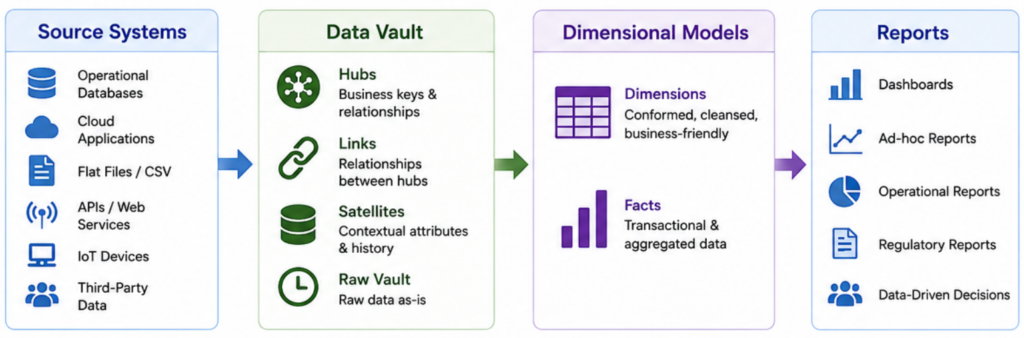
But AI is changing the consumer of enterprise data.
Increasingly, the consumer is no longer a human analyst. The consumer is:
- An AI copilot
- An intelligent agent
- A semantic search engine
- A conversational interface
- An autonomous workflow
As a result, the architecture is evolving toward:
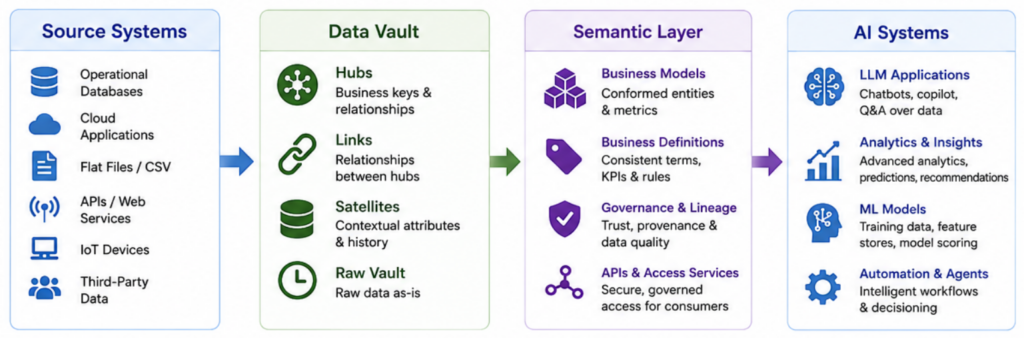
This is a profound shift because it means that Data Vault is no longer simply supporting analytics. Increasingly, it is supporting machine reasoning.
The Bigger Realization
What makes this evolution so interesting is that Data Vault was never designed specifically for AI.
It was designed to solve for enterprise instability.
But AI magnifies the exact same challenges that Data Vault was originally created to address:
- Constant change
- Evolving business logic
- Fragmented systems
- Historical ambiguity
- Semantic inconsistency
- Lineage gaps
AI simply raises the stakes because AI systems amplify both the strengths and weaknesses of the data foundations beneath them.
Closing Perspective
For years, Data Vault was often viewed as infrastructure. While important, it was nonetheless still considered infrastructure.
Generative AI changes that perspective.
As organizations move toward intelligent agents, conversational analytics, semantic reasoning systems, and autonomous enterprise workflows, the qualities that Data Vault was built around become dramatically more valuable:
- Organizational memory
- Separation of concerns
- Resiliency under change
- Process awareness
- Auditability
- Lineage
The future enterprise data platform is no longer designed solely for human consumption. It is increasingly designed for machine reasoning. And in that world, the foundational principles of Data Vault are becoming more relevant than ever. The irony is that Data Vault’s founders were not trying to solve AI. They were trying to solve enterprise complexity. It just turns out that enterprise AI has the same problem.